

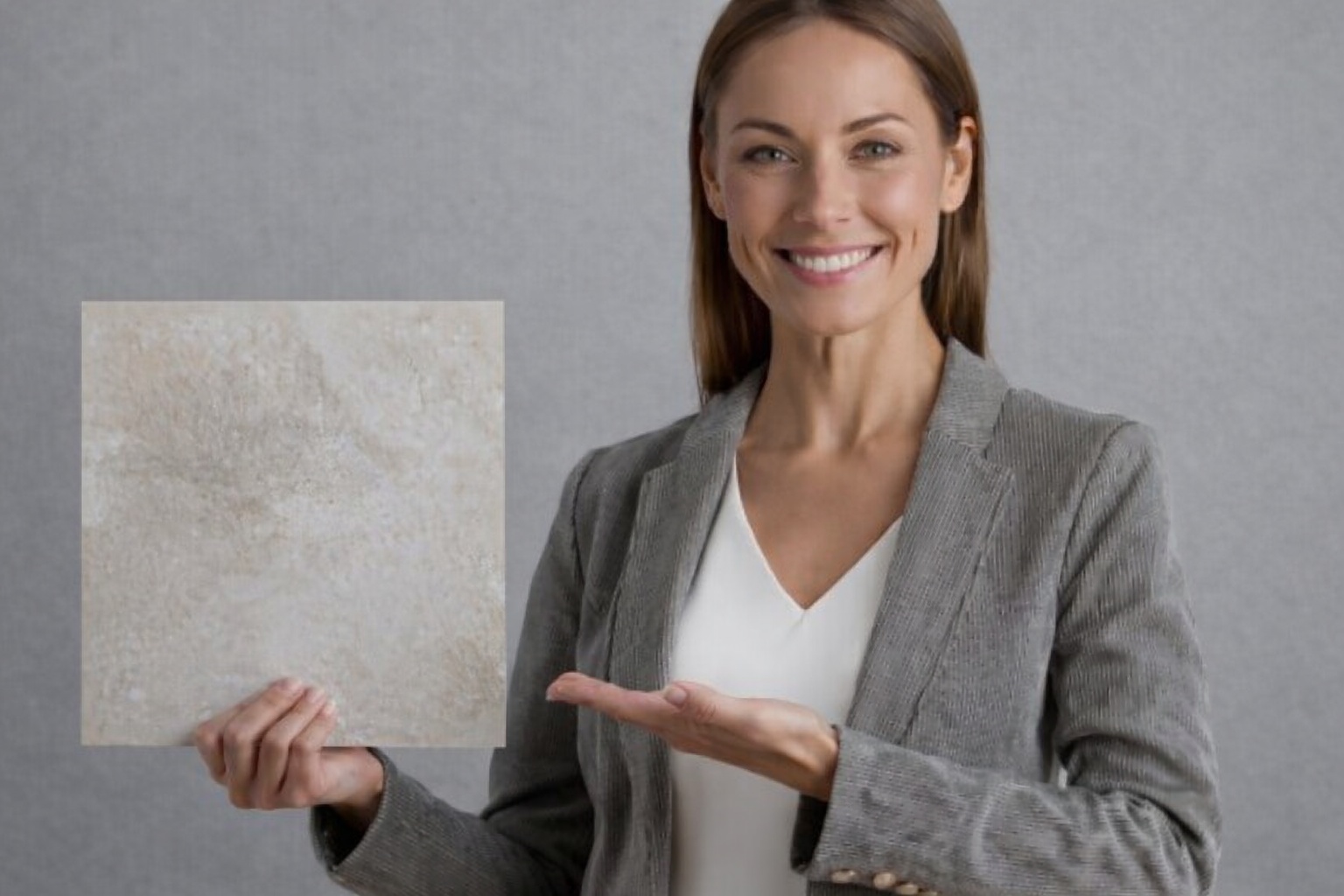
FREE ONLINE TILE SAMPLES
Our Samples are appx 10″x10″. Customers pay just $5.00 shipping per sample.
OUR PROMISE
If you are on this page, you are probably considering ordering our tile samples, which we offer free with $5 shipping each. We truly appreciate the opportunity to earn your business and will do our best to make this one of the most pleasant tile shopping experiences you’ve ever had.
How Do We Cut Our Samples, Cut Edges & Quality
For many years, we cut our tile samples using a water saw. A water saw is a machine that uses a diamond blade cooled with a constant stream of water to cut through hard materials such as porcelain and stone. The water helps keep the blade cool and reduces friction, allowing the saw to make very precise and straight cuts.
While a water saw can produce perfectly straight edges, the cutting process can generate a significant amount of dust and slurry. Over time we realized that this method was not the best option for maintaining a clean and safe working environment. For that reason, in 2024 we switched to using a 48-inch professional tile cutter.
A tile cutter works differently from a water saw. Instead of cutting through the tile with a spinning blade, it first scores the surface glaze with a hardened wheel, then applies pressure to snap the tile along that scored line. This process creates a clean break and eliminates the dust produced by saw cutting.
Although tile cutters provide a much cleaner working environment, the snapped edge does not always look perfectly straight beneath the glaze when viewed from the side. From the top, the sample appears perfectly cut, but the side profile can look slightly uneven.
Sometimes this leads customers to ask an important question:
“Am I receiving a rectified tile?”
The answer is yes. All of our porcelain tiles are rectified. The difference is that the sample you receive has been cut from a full tile, so what you see on the sample edge is not the factory-finished edge.
Your actual tiles will arrive in their original boxes with perfectly rectified factory edges.
These boxes are also clearly labeled A Quality, 1st Quality, or 1st Choice, which indicates the highest production grade. Tile factories do sell products that do not pass full quality control, but those tiles are always labeled 2nd Quality, B Quality, or 2nd Choice.
Premium tile manufacturers are often tens of millions, and sometimes hundreds of millions of dollars in size, and they operate under strict quality standards. With containers holding over 700 boxes of tile, re-boxing or mislabeling products would be both impractical and far more expensive than simply selling properly graded material.
While a water saw can produce perfectly straight edges, the cutting process can generate a significant amount of dust and slurry. Over time we realized that this method was not the best option for maintaining a clean and safe working environment. For that reason, in 2024 we switched to using a 48-inch professional tile cutter.
A tile cutter works differently from a water saw. Instead of cutting through the tile with a spinning blade, it first scores the surface glaze with a hardened wheel, then applies pressure to snap the tile along that scored line. This process creates a clean break and eliminates the dust produced by saw cutting.
Although tile cutters provide a much cleaner working environment, the snapped edge does not always look perfectly straight beneath the glaze when viewed from the side. From the top, the sample appears perfectly cut, but the side profile can look slightly uneven.
Sometimes this leads customers to ask an important question:
“Am I receiving a rectified tile?”
The answer is yes. All of our porcelain tiles are rectified. The difference is that the sample you receive has been cut from a full tile, so what you see on the sample edge is not the factory-finished edge.
Your actual tiles will arrive in their original boxes with perfectly rectified factory edges.
These boxes are also clearly labeled A Quality, 1st Quality, or 1st Choice, which indicates the highest production grade. Tile factories do sell products that do not pass full quality control, but those tiles are always labeled 2nd Quality, B Quality, or 2nd Choice.
Premium tile manufacturers are often tens of millions, and sometimes hundreds of millions of dollars in size, and they operate under strict quality standards. With containers holding over 700 boxes of tile, re-boxing or mislabeling products would be both impractical and far more expensive than simply selling properly graded material.
How to Evaluate a Tile Sample
Our tile samples serve three purposes: to show the true color tone that cannot always be captured in pictures, to let you feel the surface texture, and to give you a general sense of the tile.
When evaluating a tile sample, place it on the floor and step back. Tiles are designed to be seen from a distance, where the small details come together to create their character. When you look at a tile from only a foot away, those details can appear stronger than they will once the tile is installed. It is similar to looking at an original painting too closely and seeing nothing but brush strokes.
Many tiles are also produced in multiple sizes with the same color and design. The main difference between a sample cut from a 24×48 tile and one cut from a 48×48 tile is the thickness of the tile. If the thickness of the sample you receive matches the lower value indicated for the tile thickness on the back of the sample, it simply means that the sample was cut from a smaller tile size. Larger tiles are more expensive and harder to handle, and because we cut a large number of samples every day, we often cut samples from the smaller size of the same tile collection.
When evaluating a tile sample, place it on the floor and step back. Tiles are designed to be seen from a distance, where the small details come together to create their character. When you look at a tile from only a foot away, those details can appear stronger than they will once the tile is installed. It is similar to looking at an original painting too closely and seeing nothing but brush strokes.
Many tiles are also produced in multiple sizes with the same color and design. The main difference between a sample cut from a 24×48 tile and one cut from a 48×48 tile is the thickness of the tile. If the thickness of the sample you receive matches the lower value indicated for the tile thickness on the back of the sample, it simply means that the sample was cut from a smaller tile size. Larger tiles are more expensive and harder to handle, and because we cut a large number of samples every day, we often cut samples from the smaller size of the same tile collection.
A Little Scratch on a Polished Tile Sample
Porcelain tiles are extremely hard materials. When they are packaged at the factory, tiles are stacked on top of each other with small dots of hot glue on the glazed surface. These glue points keep the rough porcelain body of the tile above about 1 mm away from the polished surface below, preventing damage during transportation.
However, once a box is opened in a warehouse, the situation changes. Staff usually remove the top tile to show customers, and during this process the polished surface can occasionally come into contact with other tiles or hard surfaces. Because warehouses are full of heavy porcelain materials, small scratches can sometimes occur on polished samples.
This type of environment is very different from a typical home, where objects as hard as porcelain tiles are rarely present. For that reason, while a sample tile may occasionally show a small scratch, the tiles you receive in your order will not. All orders are shipped in original factory boxes, ensuring that the tiles arrive in perfect condition.
You can read more about tile scratch resistance here.You can read about tile scratch resistance here
However, once a box is opened in a warehouse, the situation changes. Staff usually remove the top tile to show customers, and during this process the polished surface can occasionally come into contact with other tiles or hard surfaces. Because warehouses are full of heavy porcelain materials, small scratches can sometimes occur on polished samples.
This type of environment is very different from a typical home, where objects as hard as porcelain tiles are rarely present. For that reason, while a sample tile may occasionally show a small scratch, the tiles you receive in your order will not. All orders are shipped in original factory boxes, ensuring that the tiles arrive in perfect condition.
You can read more about tile scratch resistance here.You can read about tile scratch resistance here
Why to Choose Our Online Tile Samples?
Most online tile stores offer 4×4-inch samples (often 5 samples for $5), which work for solid-colored tiles but are too small for tiles with intricate designs. A small cut won’t capture the full color variations or face patterns. At Tiles & Stone Warehouse, we offer 8× larger, 10×10-inch, 4-lb samples for FREE, shipped for just $5 each—a significantly better deal that gives you a true feel for the tile you liked online, while still small enough to carry.
The Advantage of Large Samples:
The Advantages of Larger Samples
• See the tile under your home’s lighting — No surprises from showroom lighting or edited online images.
• Compare across different rooms — Test how the tile works with your space, wall colors, and furniture.
• Better understand the tile’s surface texture — A larger sample makes it easier to see the finish and feel how the tile will interact with light.
• Easier to evaluate in your space — Large enough to judge color and texture, yet small enough to move around your home.
• See the tile under your home’s lighting — No surprises from showroom lighting or edited online images.
• Compare across different rooms — Test how the tile works with your space, wall colors, and furniture.
• Better understand the tile’s surface texture — A larger sample makes it easier to see the finish and feel how the tile will interact with light.
• Easier to evaluate in your space — Large enough to judge color and texture, yet small enough to move around your home.

Get Your Free Tile Samples Online
Begin your journey with confidence.